
Helping you do more, with care.
Our philosophy starts with a simple belief: healthcare should be accessible to everyone.
One of the biggest reasons healthcare is not as accessible as it should be is that demand often exceeds the capacity of clinics. We help build that capacity — but what makes our approach different is that we do not believe capacity should come from asking clinical teams to rush, compromise quality, or reduce care to its bare minimum.
Healthcare has two parts: health and care. Better health outcomes matter deeply, but so does the experience of being cared for. Patients are more likely to return, follow their care plans, and stay connected to a clinic when they feel respected.
That is why our work focuses on identifying inefficiencies without weakening the human side of care. We look for ways to improve care pathways and make better use of existing resources — while protecting the moments that matter in clinical practice. Sometimes those moments are clinical. Sometimes they are human: a kind word or a little extra attention that makes the patient experience feel personal.
We believe that anything that strengthens patient engagement also strengthens the clinic. When patients return for checkups, follow their care plans, and remain connected to their providers, care becomes more continuous, clinics build more robust patient rosters, and the relationship between patient and provider becomes stronger.
So for us, capacity is not about doing more for the sake of doing more. It is about helping clinics do more, with care. It is about creating the conditions for more patients to access care, and for clinics to welcome more people through their doors without needing to compromise on the quality, trust, and attention that make care meaningful.
In a field where operational data can too easily be treated as just a set of numbers, we want to shift the paradigm back to what this work should really be about: helping more patients receive care, helping clinics sustain and grow the care they provide, and preserving the human side of healthcare as capacity increases.


Meet our team
Hubert Michalus
Hubert’s idea for Costara started with a clear goal: to help expand access to care by helping healthcare organizations understand where their resources are actually going. His work includes leading one of Canada’s first time-driven activity-based costing studies in healthcare and developing a first-of-its-kind interactive costing tool based on TDABC.
For Hubert, cost data are not just numbers. They tell the story of how care is delivered: where time is spent, where inefficiencies hide, and where workflows can be improved. This perspective shapes Costara’s work: using rigorous costing methods to help teams understand that story clearly and act on it.
Hubert brings experience across public and private-sector healthcare research, with work spanning Canadian and international contexts. He holds an MSc in Population and Public Health, specializing in Health Economics, from the University of British Columbia, and a BSc (Honours) in Political Science from the Université de Montréal. He works with clients in English, French, and Polish.
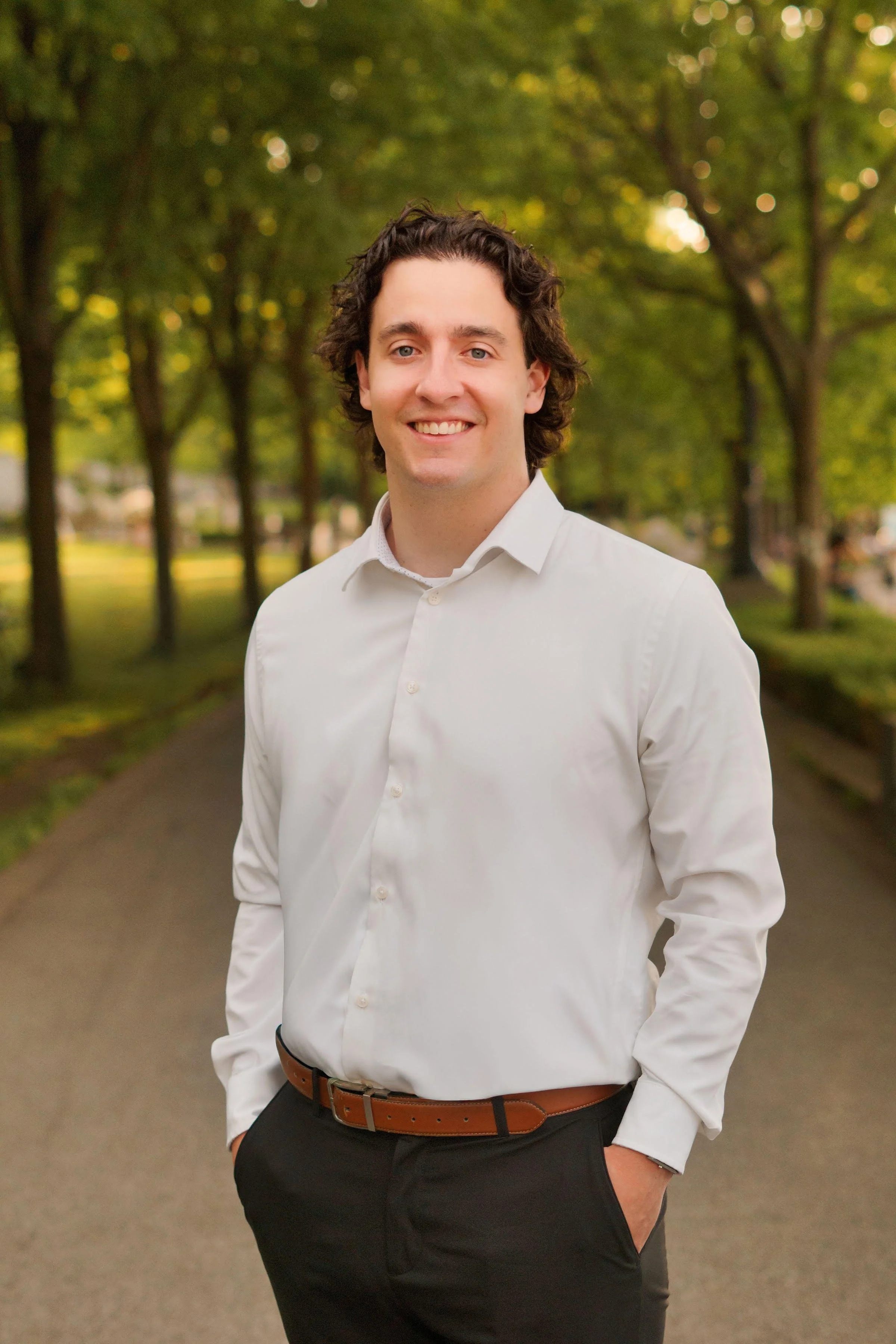
Liam Quinn
Liam's motivation to co-found Costara is grounded in nearly a decade of frontline experience in mental health and addictions care and clinical leadership. That work made clear that the costs of healthcare inefficiency extend beyond wait times, with real consequences for the well-being of those receiving and delivering care.
His experience spans non-profit and government agencies across Western Canada, giving him an applied understanding of where systems strain and where targeted change is most likely to hold. That perspective informs how Costara engages with clinical staff and designs tools that fit the realities of the organizations using them.
Liam holds a BA (Honours) in Psychology and a BHSc in Addictions Counselling from the University of Lethbridge, and is completing his MA in Counselling Psychology at the University of British Columbia.